In today’s digital ecosystem, the way content is consumed is changing faster than ever. With the rise of AI summarizers and generative search results, your articles and web pages are no longer just competing for a position on search engines; they are competing for how they will be condensed and presented in AI-generated summaries. This new wave of content distribution has redefined how businesses, marketers, and publishers need to approach AI content optimization.
If you’ve already invested in SEO marketing services or are familiar with modern content strategies, you know that the rules of search visibility continue to evolve. But optimizing content for AI-driven summaries requires a balance of clarity, structure, and topical depth. Whether you’re writing for a blog, creating long-form resources, or working on website content optimization, you need to think about how AI tools digest and repurpose your text.
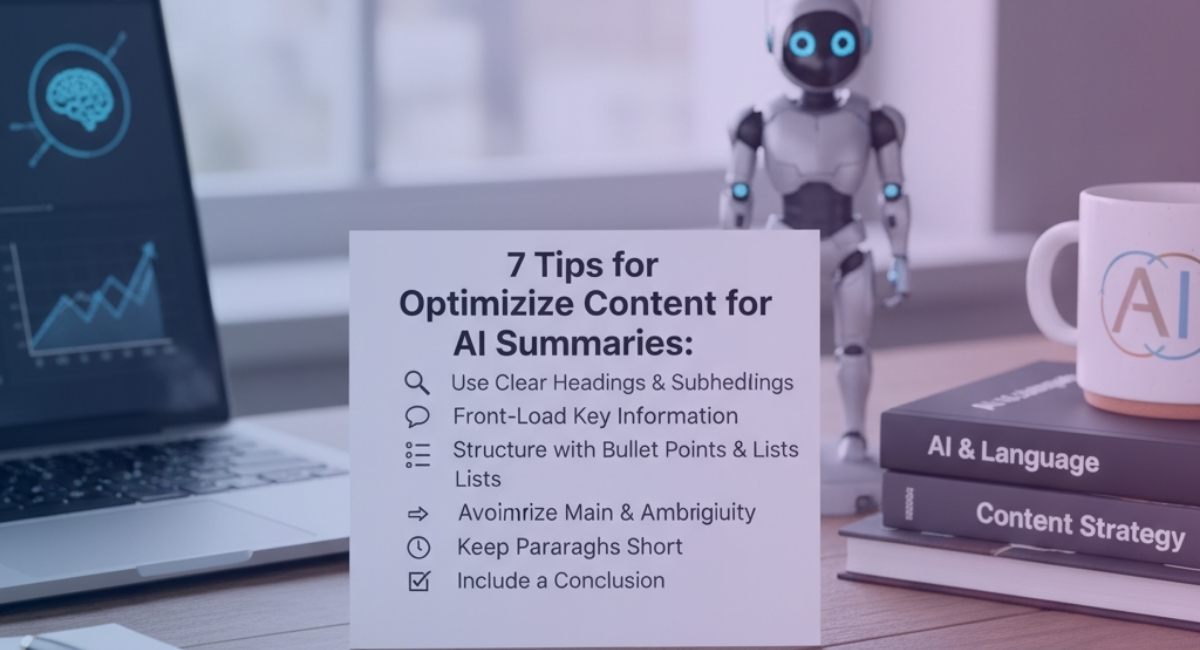
Below is a complete manual with 7 practical tips for optimizing content for AI-generated summaries. Each strategy is based on real-world writing practices, SEO principles, and the evolving behavior of AI-powered search results.
Why AI Summaries Matter for Content Visibility
Before diving into the practical guide, it’s important to understand why optimization for AI summaries is becoming a critical factor in digital visibility. When a user searches for information, AI tools don’t always show entire web pages. Instead, they generate short overviews, direct answers, or condensed explanations. If your content is written in a way that makes it easy for AI to extract accurate and concise details, your brand has a higher chance of being featured in these summaries.
For teams that want to connect summary-friendly writing with measurable AI visibility, Wellows is an AI visibility platform that tracks how often brands appear across ChatGPT, Gemini, Perplexity, AI Overviews, and AI Mode. It also surfaces visibility gaps and content opportunities, making it easier to see whether clearer structure, stronger context, and better formatting are actually leading to more AI citations.
This is especially important for content marketing in the age of AI, where AI-powered platforms are increasingly replacing traditional snippets. Being included in AI overviews increases traffic, boosts credibility, and positions your website as a trusted authority in its niche.
For example, if you are running an eCommerce store and want your product guides to stand out, working with a professional team that provides eCommerce SEO services can ensure that both your human readers and AI systems can easily extract the right product-related information.
7 Tips for Optimizing Content for AI Summaries
1. Write with Clear Hierarchical Structure
AI summarizers rely heavily on well-structured text. Headings, subheadings, and bullet points act as markers that help AI tools understand the hierarchy of information. Instead of writing in long, unbroken paragraphs, break down your content into small, digestible parts.
- Use H2 and H3 tags naturally
- Create sections that address single topics
- Insert lists and short bullet points when explaining steps
When you design your content like this, AI finds it easier to generate accurate short summaries without losing the context of your writing.
2. Focus on Semantic SEO and Contextual Clarity
Traditional keyword stuffing does not work for AI-driven search. Instead, semantic SEO is key. Semantic SEO means covering the topic in full depth using related terms, natural variations, and contextual cues that help AI tools connect concepts.
For example, if you are writing about how to write for AI summarizers, you shouldn’t only repeat that phrase. Use related variations like AI search result summaries optimization or improve visibility in AI-generated answers. This creates a topical authority signal, which AI systems use to evaluate which content is most reliable to summarize.
Adding links to relevant resources, such as AI SEO services, further enhances your topical authority and sends trust signals to search engines and AI summarizers alike.
3. Prioritize Concise and Informative Sentences
AI summaries extract the most relevant phrases and sentences from your writing. If your content is cluttered with filler text, repetitive phrases, or overly complex wording, AI tools may misinterpret the main idea.
Instead, write in short, meaningful sentences. For example:
| Writing Style | Example Sentence |
| Complex & vague | “With an ever-increasing focus on the changing landscape of online search, marketers need to unlock potential strategies for staying ahead.” |
| Optimized & clear | “Marketers should optimize content so AI tools can summarize it clearly for search results.” |
Conciseness improves the chances of your sentences being featured as AI-generated summaries.
4. Add Contextual Data and Examples
AI thrives on examples, statistics, and clear data points because these elements are often highlighted in summaries. Instead of writing only abstract explanations, back your points with concrete examples.
For instance, when explaining AI-first content strategy, you could provide a table comparing traditional SEO with AI-optimized SEO:
| Approach | Traditional SEO | AI-First SEO |
| Keyword use | Focus on single keywords | Focus on semantic clusters |
| Content format | Long-form blogs | Structured, summary-friendly content |
| Ranking signals | Backlinks and keywords | Clarity, topical authority, contextual depth |
Tables like these improve readability and signal to AI tools that your content is designed for structured summarization.
5. Create Human-Centered yet AI-Friendly Flow
Some content creators make the mistake of writing only for AI tools. The risk here is that the text may feel robotic, unnatural, or overly optimized. AI summarizers are designed to replicate human understanding, so if your content is unengaging to readers, it will also be less effective for AI summaries.
Write with an engaging tone, address user intent, and keep readers in mind. If you are publishing a guide on website content optimization, make sure it’s equally useful for a reader who wants to learn best practices and for AI tools that will present snippets from your article.
For example, if you are working on a brand blog, you can incorporate insights like those shared in digital marketing trends in 2025, blending engaging storytelling with AI-ready clarity.
6. Integrate Internal Linking Strategically
Internal linking helps both search engines and AI summarizers understand the relationships between different content pieces on your site. When optimizing content for AI summaries, link naturally to relevant services, guides, or blogs.
For example:
- When discussing content clarity, you can reference blog writing services to highlight how professional writing improves readability.
- While explaining technical aspects, linking to technical SEO services can provide readers with deeper resources.
Internal linking strengthens the semantic network of your website, which AI tools recognize when choosing which content to summarize.
7. Continuously Update and Refine Content
AI summaries often prioritize the freshest and most updated content. Articles that are regularly reviewed and refined tend to be favored in AI-driven overviews. Outdated examples, old statistics, or broken links can reduce the likelihood of your content being selected for summarization.
To keep your content competitive:
- Review old articles quarterly
- Update outdated statistics and references
- Add new examples or data points that reflect current trends
For example, if you originally wrote about AI summaries in 2022, update your article with current insights on content marketing in the age of AI to remain relevant.
Frequently Asked Questions
1. How can I optimize blog posts for AI summarizers?
Start with clear structure, concise sentences, and semantic keyword variations. Use subheadings and examples that allow AI to easily identify the main points.
2. Do AI summaries replace traditional SEO?
No, they complement SEO. Traditional SEO signals like backlinks, on-page optimization, and authority are still essential. AI summaries add another layer of visibility.
3. Can internal linking improve my chances of being featured in AI summaries?
Yes. Proper internal linking to relevant service pages and related blogs improves topical depth and helps AI systems understand your website’s expertise.
4. Should I use technical SEO for AI-driven content optimization?
Absolutely. Technical SEO ensures your site’s structure, speed, and metadata are aligned with both search engines and AI-powered indexing systems.
5. What industries benefit most from AI summaries optimization?
Every industry benefits, but eCommerce, SaaS, healthcare, and education websites see the biggest impact due to high search query volumes and demand for quick answers.
Final Thoughts
Optimizing content for AI summaries is not just about writing short sentences or sprinkling in keywords. It’s about building a comprehensive strategy that balances human readability, semantic SEO, and AI-first design. From structuring content clearly to integrating examples and refining with updates, every element contributes to better visibility in AI-powered overviews.
If your business is serious about ranking in this new AI-driven environment, investing in professional SEO strategies can make all the difference. For tailored guidance on AI SEO services and content optimization, connect with Buzz Marketing. Our expertise in SEO marketing, web content optimization, and AI-driven strategies ensures that your brand is ready for the future of search visibility.