A consulting firm runs paid ads for three months. Impressions climb, the website gets steady visits, and the marketing team feels good about the numbers. Then someone asks a simple question: how many of these visitors actually became clients. The honest answer is almost none.
This happens constantly in service businesses selling anything that requires trust, budget approval, or a longer decision process. Legal services, B2B software, financial consulting, and marketing agencies all share the same problem. People do not buy on the first visit. A funnel built for impulse purchases does not work for decisions that take weeks or months.
Why High-Consideration Services Need a Different Funnel
A high-consideration purchase involves real risk for the buyer. Choosing the wrong consultant wastes budget and time. Signing with the wrong software vendor creates months of internal disruption. Because the stakes are higher, buyers research more, compare more options, and wait longer before reaching out.
This changes what a funnel needs to accomplish at each stage. A funnel built for a low cost product might move someone from an ad to a purchase within a single session. A funnel for a service business needs to account for multiple touchpoints across weeks, sometimes involving several people inside the buyer’s organization who all need to agree before a decision gets made.
Businesses that treat both types of purchases the same way often see disappointing results from paid campaigns. Ads generate clicks, but the offer asks for too much too soon, such as a direct sales call before the visitor has any reason to trust the business. The mismatch between where the buyer actually is in their decision process and what the funnel asks them to do is one of the most common reasons lead generation campaigns underperform for service businesses.
The Core Stages of a Digital Marketing Funnel
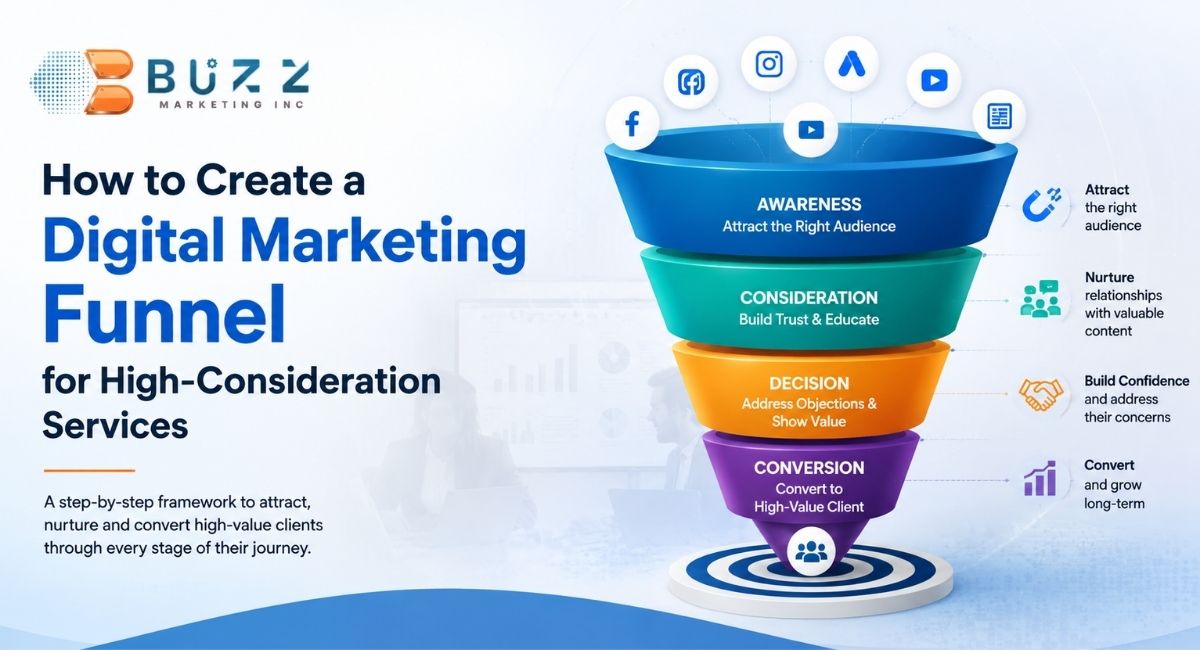
A funnel built for high-consideration services generally moves through four stages. Each stage has a different goal, a different type of content, and a different way of measuring success.
| Funnel Stage | Buyer Mindset | Primary Goal | Typical Content |
| Awareness | Recognizing a problem exists | Get noticed by the right audience | Blog content, social posts, top of funnel ads |
| Consideration | Comparing possible solutions | Build trust and demonstrate expertise | Case studies, webinars, comparison guides |
| Decision | Evaluating specific providers | Convert interest into a qualified lead | Consultations, demos, detailed proposals |
| Retention | Post purchase relationship | Turn clients into repeat business and referrals | Onboarding content, check ins, loyalty offers |
This structure is not rigid. Some buyers move through it in days, others take months, and some skip back and forth between stages before committing. The point of mapping these stages is not to force every prospect through an identical path, but to make sure the business has the right content and offer ready at whichever stage a prospect happens to be in.
Awareness: Getting Found by the Right People
At the top of the funnel, the goal is visibility among people who are likely to need the service eventually, even if they are not ready to buy today. This stage relies heavily on content that answers early stage questions, along with paid advertising that introduces the brand to a relevant audience.
Google Ads works well here for capturing people actively searching for a solution, even in early research mode. Someone searching “how to reduce customer churn” is not ready to hire a consultant yet, but they are signaling a real problem worth addressing with helpful content rather than a hard sell.
Meta Ads serve a different purpose at this stage. Rather than capturing active search intent, they introduce a brand to an audience defined by interests, behaviors, or lookalike profiles based on existing customers. For B2B and professional services, this is often more effective for building initial awareness than for driving immediate conversions.
Content built for this stage should educate without asking for anything in return beyond attention. Blog posts, short videos, and social content that explain a problem clearly tend to perform better here than content that jumps straight into a sales pitch.
Consideration: Building Enough Trust to Move Forward
Once a prospect recognizes their problem and starts researching solutions, the funnel needs to shift toward proving credibility. This is where many service businesses lose potential clients, because they either rush prospects toward a sales call too early or fail to provide enough substance to differentiate themselves from competitors.
Case studies matter more at this stage than almost any other content type, since they show real outcomes with real context rather than general claims about expertise. A prospect comparing three consulting firms is far more persuaded by a detailed account of how a similar business solved a similar problem than by a page listing services offered.
Webinars and detailed guides also work well here, particularly for B2B audiences where a purchase decision often involves more than one stakeholder. A webinar recording can be shared internally within a prospect’s company, extending its reach beyond the person who initially attended.
Retargeting campaigns become useful once a prospect has already engaged with awareness stage content. Rather than showing a generic ad to someone who has never heard of the business, retargeting can serve more specific content, such as a case study relevant to the visitor’s industry or role.
Decision: Turning Interest Into a Qualified Lead
The decision stage is where a business needs to convert genuine interest into a qualified lead, meaning someone who has both the need and the authority or budget to move forward. This is different from simply generating any lead, since a high volume of unqualified inquiries often wastes more sales time than it saves.
A well designed decision stage offer removes friction while still filtering for genuine intent. A short discovery call, a personalized proposal request, or a detailed consultation booking form all work better than a generic contact form, since they signal a specific next step rather than a vague invitation to get in touch.
Lead qualification questions built into forms help sales teams prioritize their time. Asking about budget range, timeline, or company size at this stage is reasonable, since a prospect who has already engaged with awareness and consideration content is more willing to share this information than someone encountering the business for the first time.
A customer relationship management platform such as HubSpot becomes essential at this stage, allowing a business to track where each lead came from, what content they engaged with, and how quickly they move through the pipeline. Without this visibility, it becomes difficult to know which parts of the funnel are actually producing qualified leads versus which parts are generating traffic that never converts.
Retention: Keeping the Relationship After the Sale
Many service businesses stop thinking about the funnel once a client signs on, but retention deserves its own attention, particularly for businesses where repeat engagements or referrals make up a significant share of revenue.
Onboarding content that sets clear expectations reduces early client frustration and improves the odds of a long term relationship. Regular check ins, useful updates, and occasional value added content keep the relationship active rather than transactional. Clients who feel genuinely supported are more likely to refer others, which often produces some of the highest quality leads a service business can get, since referred prospects arrive with built in trust.
Mapping Funnel Content to Buyer Questions
A practical way to build funnel content is to list the actual questions prospects ask at each stage, based on real conversations with the sales team or client feedback, rather than guessing based on assumptions.
For an accounting firm, awareness stage questions might include general concerns about tax obligations or bookkeeping best practices. Consideration stage questions shift toward comparing service models, such as in house bookkeeping versus outsourced accounting. Decision stage questions become specific, such as pricing structures or onboarding timelines.
Building content around these actual questions, rather than generic industry topics, tends to attract a more relevant audience and produces content that naturally supports the buyer at whichever stage they are in.
Some practical steps for mapping this out:
- Interview the sales team about the most common questions prospects ask before signing
- Review past client emails or call notes for recurring concerns and objections
- Group these questions by funnel stage based on how specific and decision focused they are
- Assign each question to a content format that fits the stage, such as a blog post for awareness or a detailed proposal template for the decision stage
- Update this list quarterly as new questions or objections emerge
Choosing the Right Channels for Each Stage
Not every channel performs equally well at every funnel stage, and spreading budget evenly across all of them often produces weaker results than focusing spend where each channel is strongest.
Search advertising through Google Ads tends to perform best at the consideration and decision stages, since it captures people actively searching for a solution rather than passively scrolling. Search intent is a strong signal of readiness, which makes this channel efficient for capturing demand that already exists.
Social advertising through Meta Ads is generally stronger for building awareness and staying visible through the consideration stage via retargeting, rather than driving cold traffic straight to a decision stage offer. For B2B service businesses, LinkedIn based advertising often plays a similar role, particularly when targeting by job title or company size matters more than broad interest categories.
Email remains one of the most cost effective channels for moving prospects through the consideration stage once they have provided contact information. A well built email nurture sequence can share case studies, answer common objections, and gradually build toward a decision stage offer without requiring ongoing ad spend for every touchpoint. Reviewing solid email marketing best practices is worth doing before building this sequence, since poorly timed or overly frequent emails can undo the trust built earlier in the funnel.
Organic content, including blog articles and search visibility, works across every stage but takes longer to build momentum than paid channels. It tends to produce the most cost efficient leads over time once a library of content exists, though it requires patience compared to the faster feedback loop of paid advertising.
A Practical Scenario
Consider a mid sized marketing agency trying to attract more B2B clients. Early campaigns focused entirely on driving traffic to a “book a call” page through Google Ads. Conversion rates stayed low, and the sales team complained that most calls were unqualified, coming from people who were not ready to hire an agency or did not have the budget to do so.
The agency restructured its approach. Awareness stage blog content addressed common early stage questions about when a business should consider outsourcing marketing. A consideration stage case study series highlighted specific client results with enough detail to be genuinely useful rather than promotional. The decision stage offer changed from a generic call booking to a short qualification form asking about current marketing spend and team size, followed by a scheduled strategy call.
Within a few months, total lead volume dropped, but the sales team reported a much higher percentage of qualified conversations. Tracking through Google Analytics 4 showed that visitors who engaged with at least one case study before reaching the contact form converted to a booked call at a noticeably higher rate than those who went directly from an ad to the form.
Measuring Funnel Performance
A funnel is only useful if a business can see where prospects drop off and which stages need improvement. Google Analytics 4 supports this through event based tracking, allowing a business to follow a visitor’s actions across multiple sessions rather than treating each visit as isolated.
Setting up funnel visualization within Google Analytics 4 helps identify exactly where prospects are leaving the process, whether that is at the initial landing page, during a form submission, or after downloading a resource without ever booking a call. This data is far more useful than overall traffic numbers, since it points directly to which stage needs attention.
| Funnel Stage | Key Metric | What a Weak Number Suggests |
| Awareness | Reach and engagement rate | Targeting may be too broad or content is not resonating |
| Consideration | Content engagement, email open rate | Offer may lack relevance or trust signals |
| Decision | Form completion rate, call booking rate | Offer may ask for too much too soon |
| Retention | Repeat engagement, referral rate | Onboarding or follow up may need improvement |
Reviewing performance regularly matters more than any single metric in isolation. A broader look at which digital marketing metrics to track weekly helps place funnel specific data in context alongside overall campaign performance, so decisions are based on a complete picture rather than one number viewed in isolation.
For businesses trying to decide which numbers actually matter for their specific goals, a review of the strongest KPIs for measuring digital campaign success can help narrow focus to the metrics that genuinely reflect funnel health rather than vanity numbers that look good but do not connect to actual business outcomes.
Common Mistakes That Weaken a Service Business Funnel
A few recurring issues show up when service businesses build funnels without enough attention to the buyer’s actual decision process.
The first is asking for too much commitment too early, such as requesting a sales call from someone who just clicked an awareness stage ad and has never heard of the business before. This mismatch between offer and readiness drives away prospects who might have converted with a lower commitment first step.
The second is treating every lead the same regardless of source or engagement level, sending identical follow up to someone who downloaded a single resource and someone who has read multiple case studies and attended a webinar. Lead scoring, even in a simple form, helps sales teams prioritize genuinely warm prospects.
The third is neglecting the middle of the funnel entirely, moving straight from awareness content to a decision stage offer with nothing in between to build trust. This gap is where most high-consideration purchases actually get lost.
The fourth is failing to track the funnel as a connected system, looking at ad performance, content engagement, and sales conversions as separate reports rather than one continuous journey. Without this connected view, it becomes difficult to know which upstream activity is actually driving downstream results.
A short list of fixes worth applying across most of these issues:
- Match every offer to the appropriate stage of buyer readiness
- Build at least one substantial trust building asset for the consideration stage before scaling paid traffic
- Score or tag leads based on engagement level rather than treating all inquiries equally
- Connect campaign, content, and CRM data so the full funnel can be reviewed as one system
Bringing the Funnel Together
A digital marketing funnel for a high-consideration service is not a single campaign or a single landing page. It is a connected system where awareness content, trust building assets, and a well matched decision stage offer work together to move a prospect from first contact to qualified lead without asking for more commitment than they are ready to give at each point.
Businesses producing a steady flow of awareness and consideration stage content often benefit from organizing that content around clear topics rather than publishing disconnected posts. A related approach worth reviewing is how to build a topic cluster strategy, since a well organized content library tends to support every funnel stage more effectively than isolated articles competing for the same attention.
Paid advertising remains one of the fastest ways to fill the top of the funnel with a relevant audience. Buzz Marketing’s Google Ads management services focus on matching campaign structure to buyer intent rather than driving traffic that never converts, while LinkedIn advertising can be particularly effective for B2B service businesses targeting specific roles or company sizes.
Once traffic reaches the decision stage, the offer itself needs to convert at a reasonable rate, which is where conversion rate optimization becomes relevant, refining forms, page layout, and calls to action so qualified visitors do not drop off at the final step.
Digital Marketing Funnel Questions, Answered
How long should a funnel take for a high-consideration service?
There is no fixed timeline, since it depends on the price point and complexity of the service. Many B2B and professional service funnels span several weeks to a few months, with multiple touchpoints across content, email, and paid channels before a prospect is ready to have a sales conversation.
Should every prospect go through all four funnel stages?
Not necessarily. Some prospects arrive already familiar with a business through a referral and move quickly to the decision stage. The funnel structure exists to make sure content and offers exist for every stage, not to force every visitor through an identical sequence.
Is HubSpot necessary to run a funnel like this?
A dedicated CRM platform such as HubSpot makes tracking and managing leads significantly easier, especially as volume grows, but smaller businesses can start with simpler tools and adopt a more robust platform as their lead volume increases.
What is the difference between a lead and a qualified lead?
A lead is anyone who has expressed some interest, such as downloading a resource or filling out a basic form. A qualified lead has been assessed for fit, typically based on budget, timeline, or decision making authority, making them a more realistic prospect for the sales team to pursue.
How do I know if my funnel is actually working?
Track conversion rates between each stage rather than only looking at overall lead volume. A funnel that generates many leads but few qualified conversations usually has a mismatch between the offer and the buyer’s actual readiness at that stage.
Final Thoughts
Building a digital marketing funnel for a high-consideration service takes more patience than running a single campaign and hoping for conversions. It requires understanding how buyers actually move through a decision process, matching content and offers to each stage, and tracking the full journey rather than isolated metrics.
Businesses that want help structuring this kind of funnel, from top of funnel content through qualified lead generation, can work with Buzz Marketing to build a system suited to how their specific buyers actually decide, rather than applying a generic template that was never built for services with a longer sales cycle.