Most business blogs are full of posts that never talk to each other. One article covers a product feature, another covers an industry trend, a third answers a random customer question. Each one lives on its own, gets a small trickle of visits, and fades into the archive within a few months. If this sounds familiar, your content is not underperforming because it is bad. It is underperforming because it is disconnected.
This is the exact problem a topic cluster strategy is built to solve.
Why Isolated Blog Posts Stop Working Over Time
When a website publishes content without a plan, Google Search sees a collection of unrelated pages instead of a coherent subject. Search engines have gotten better at understanding context, relationships between pages, and depth of coverage on a subject. A single post, no matter how well written, rarely convinces a search engine that a site is a reliable source on a broader topic.
Businesses often notice the symptoms before they understand the cause. Traffic plateaus. New posts rank for a week, then quietly slide down the results. Older articles compete against newer ones for the same keywords, a problem known as keyword cannibalization. Bounce rates stay high because visitors land on a page, read it, and leave with no obvious next step.
These are not separate problems. They are different symptoms of the same root issue: a lack of structure connecting the content together.
What a Topic Cluster Strategy Actually Is
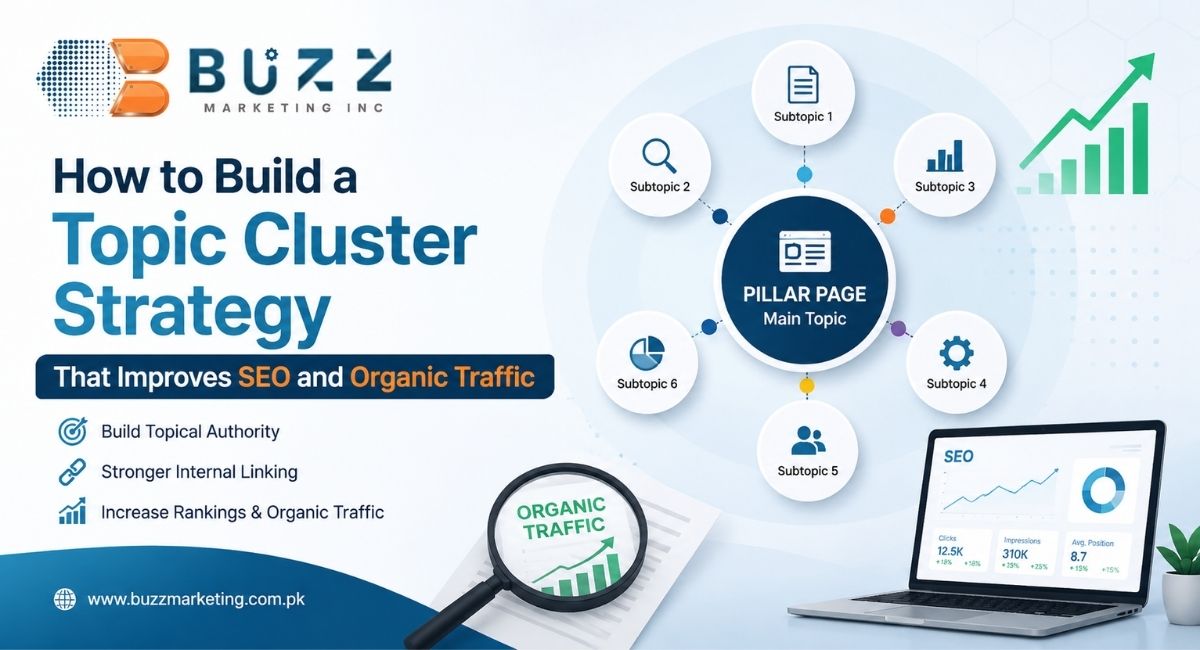
A topic cluster strategy organizes content around a central subject instead of scattering it across unrelated keywords. It has three parts.
The pillar page covers a broad topic in enough depth to serve as the main reference point. It does not try to answer every micro question in detail. Instead, it introduces the subtopics and links out to dedicated articles that go deeper into each one.
The cluster content is a group of supporting articles, each focused on a specific subtopic connected to the pillar. These posts answer narrower questions and link back to the pillar page, and often to each other where it makes sense.
The internal linking pattern ties the pillar and cluster pages together in both directions. This is the part most businesses skip, and it is the part that does the heavy lifting for search visibility.
In short, a working cluster needs:
- One pillar page covering the broad topic
- Several cluster articles, each focused on a single subtopic
- Two way internal links connecting the pillar to every cluster article
- A consistent structure that gets reviewed and expanded over time
Picture a wheel. The pillar page is the hub. Each cluster article is a spoke. The links running between them hold the structure together and signal to search engines that these pages belong to the same subject area.
Why This Structure Improves Rankings
Search engines rank pages partly based on how well a site demonstrates depth on a subject, a concept often referred to as topical authority. A site with one article about email marketing looks thin next to a site with a pillar page on email marketing supported by a dozen articles covering subject lines, automation, segmentation, and deliverability. The second site signals far more expertise on the subject, even if both sites have the same total word count.
There is also a practical crawling benefit. Internal links act as pathways for search engine bots. A well linked cluster helps new content get discovered and indexed faster, since it is connected to existing pages that already have traffic and authority rather than sitting as an orphan page with no inbound links.
Then there is the user experience angle, which search engines increasingly weigh through engagement signals. A visitor who lands on a cluster article about “email subject line testing” and finds a natural link to the broader “email marketing strategy” pillar is more likely to keep reading. Longer sessions and lower bounce rates are not the goal in themselves, but they are a natural result of giving readers a clear path to more relevant information.
How to Choose the Right Pillar Topics
Not every subject deserves a pillar page. A pillar topic needs to be broad enough to support multiple subtopics, but specific enough to stay relevant to your actual business.
Start by listing the core services or subjects your business is known for. A digital agency, for example, might consider pillar topics like search engine optimization, paid advertising, web development, or content marketing. Each of these is broad enough to branch into ten or more supporting articles.
Next, check search demand and difficulty using a keyword tool such as Ahrefs or Semrush. Look for topics with a healthy volume of searches and a mix of related long tail queries. If a topic only supports two or three subtopics, it may work better as a single article rather than a full pillar.
It also helps to review what people are already searching for through Google Search Console. The queries report shows real search terms bringing traffic to your existing pages, which often reveals subtopics you have not covered yet and pillar opportunities you might have missed.
A pillar topic is usually a good fit when it meets a few conditions:
- It connects directly to a core service or product the business offers
- It supports at least six to eight distinct subtopics
- It shows consistent search demand rather than a short lived spike
- It has room for long tail variations that can each become a cluster article
A Practical Example
Say a business offers search engine optimization services. Instead of publishing standalone posts titled “best keywords for 2025” or “why SEO matters,” they build a pillar page called “The Complete Guide to SEO for Growing Businesses.” That page briefly covers on page SEO, technical SEO, local SEO, and content strategy, then links to a dedicated cluster article for each one. Readers researching local SEO also see natural links to their own SEO marketing services, since the topic connects directly to what the business offers.
This structure lets the business rank for the competitive head term while also capturing long tail searches through the individual cluster posts.
Mapping Your Existing Content Before Creating New Pages
Before writing anything new, audit what already exists. Most businesses that have been publishing for a year or more already have the raw material for several clusters. They just never organized it.
Export a list of every published blog post along with its URL, primary keyword, and current organic traffic from Google Search Console. Group the list by subject rather than by publish date. Patterns usually appear quickly. A business might discover it has six articles that could form a cluster around content marketing, but none of them link to each other.
| Content Audit Step | What to Check | Tool to Use |
| List existing URLs | Every published post and page | Google Search Console |
| Group by subject | Which posts share a common theme | Spreadsheet or content grouping tool |
| Check keyword overlap | Posts competing for the same terms | Ahrefs or Semrush |
| Identify gaps | Subtopics with no coverage yet | Keyword research tools |
| Assign pillar candidates | Broadest topic per group | Manual review |
Once grouped, identify which existing post is the best candidate to become the pillar page. It is often the article with the broadest scope and the most existing backlinks or traffic, even if it needs a substantial rewrite to serve as a hub.
Building the Pillar Page
A pillar page is not simply a long article. It needs a specific structure to function as a hub.
Open with a clear overview of the topic that orients a reader who knows little about the subject. Follow with organized sections, each summarizing a subtopic in two or three paragraphs before linking to the full cluster article for readers who want more depth. Avoid cramming exhaustive detail into the pillar itself. If the pillar tries to cover everything, it competes with its own cluster pages instead of supporting them.
Keep the structure scannable with descriptive H2 and H3 headings, since both readers and search engines rely on this hierarchy to understand the page. Use keyword rich anchor text when linking to cluster pages so the connection between pillar and subtopic is clear to search engines and to readers scanning the page.
Length matters less than completeness. A pillar page should feel thorough without feeling padded. Some pillars run 2000 words, others run 4000, depending on how many subtopics the subject naturally supports.
Creating the Cluster Content
Each cluster article should target a specific long tail keyword or question related to the pillar topic. The goal is depth on one narrow angle rather than a repeat of the pillar’s overview.
Keep every cluster article focused on a single subtopic. An article about “technical SEO audits” should not wander into general SEO advice already covered on the pillar page. That overlap creates competition between pages instead of clear separation.
Link back to the pillar page early in the article, usually within the first few paragraphs, and use anchor text that reflects the broader topic rather than generic phrases like “click here.” Where relevant, link across to sibling cluster articles as well. If a post about email automation naturally references subject line testing, a contextual link to that companion article strengthens the cluster without forcing the connection.
Businesses producing a steady stream of these focused articles often lean on structured writing support to keep quality and voice consistent across dozens of posts. Buzz Marketing’s blog writing services are built around exactly this kind of consistent, research backed content production.
Internal Linking Rules That Actually Work
Internal linking inside a topic cluster is not about scattering links wherever they fit. A few rules keep the structure clean.
Link from every cluster page to its pillar page, and from the pillar page to every cluster page. This two way connection is what defines a cluster instead of a loose group of related articles.
Use descriptive anchor text that reflects the destination page’s topic, since generic anchors like “read more” give search engines little context about the linked page. Avoid linking to the same page with the exact same anchor text repeatedly across the site, as this can look manipulative rather than natural.
Limit the number of internal links on a single page to what genuinely helps the reader. A page with fifty internal links buried in every paragraph is harder to read and dilutes the value of each link. Somewhere between five and fifteen contextual internal links per article is usually reasonable, depending on length.
Review internal links periodically. As new cluster articles get published, older pillar and cluster pages should get updated with links to the new content. A cluster is not something to build once and forget. It grows as the business publishes more.
A quick checklist for healthy internal linking within a cluster:
- Every cluster page links back to the pillar page
- The pillar page links out to every cluster article
- Anchor text describes the destination topic, not a generic phrase
- Sibling cluster articles link to each other where the connection is genuine
- Older pages get updated links whenever new cluster content is published
Using Data to Guide the Strategy
A topic cluster strategy works best when it is informed by real search behavior rather than guesswork.
Google Search Console shows which queries are already bringing impressions and clicks to a site, along with average position for each query. This data highlights pages that rank on page two, which are often strong candidates for a content refresh or a new supporting cluster article targeting a related term.
Ahrefs and Semrush both offer content gap tools that compare a site’s ranking keywords against competitors. Running this comparison for a pillar topic often reveals subtopics that competitors cover and a business has missed entirely, which is useful for planning the next batch of cluster articles.
Tracking should not stop after publishing. Monitor how organic traffic to the pillar page changes as more cluster articles get added and linked. A well built cluster typically shows the pillar page’s rankings improving over time, not just the individual cluster pages.
| Metric to Track | What It Tells You | Where to Find It |
| Pillar page ranking position | Overall cluster strength | Google Search Console |
| Cluster page impressions | Coverage of subtopics | Google Search Console |
| Organic traffic trend | Whether the cluster is gaining momentum | Analytics platform |
| Competitor keyword gaps | Missing subtopics | Ahrefs or Semrush |
| Internal link count per page | Structural completeness | Site crawl tool |
Common Mistakes That Weaken a Cluster
A few recurring mistakes show up when businesses attempt this structure without a clear plan.
The first is publishing cluster content without ever linking it back to the pillar. The articles exist, but the structural signal search engines rely on is missing, so the cluster provides little benefit beyond what the individual posts would have earned on their own.
The second is choosing pillar topics that are too narrow to support real subtopics. A pillar needs breadth. If a business can only think of two or three related articles, the topic is better suited to a single, well researched post.
The third is letting cluster articles overlap so much that they compete with each other for the same keyword. Each cluster article needs a distinct angle and a distinct target query, even when the subjects are closely related.
The fourth is treating the pillar page as a one time project. Search behavior shifts, new subtopics emerge, and a pillar that is not revisited every few months slowly falls behind competitors who keep updating theirs.
A fifth mistake worth naming is chasing every low value keyword variation instead of focusing on subtopics that genuinely matter to readers. It is easy to fall into the trap of publishing a cluster article for every keyword a research tool surfaces, even when several of those keywords mean roughly the same thing to a searcher. This kind of over expansion is one of the more common issues covered in a review of common SEO mistakes businesses often make, and it applies just as much to cluster planning as it does to standalone content.
To summarize, watch out for:
- Cluster articles with no link back to the pillar page
- Pillar topics too narrow to support real subtopics
- Overlapping cluster articles competing for the same keyword
- Pillar pages left untouched for a year or longer
- Publishing near duplicate articles for keyword variations that mean the same thing
How Topic Clusters Fit Into a Wider Content Strategy
Topic clusters do not exist in isolation from the rest of a marketing plan. They work best when the subtopics chosen for a cluster reflect what a business actually wants to be known for, and when the writing itself follows a consistent voice across dozens of pages.
Search behavior is also shifting toward more conversational and question based queries, partly driven by voice assistants and AI powered search summaries. A cluster built around a pillar topic naturally captures many of these longer, more specific questions, since each supporting article is already built to answer one narrow query in depth. Businesses adjusting their content for this shift often find it useful to review how voice search optimization strategies intersect with traditional keyword research, since the two are becoming harder to separate.
The rise of AI generated answer boxes and summary panels in search results adds another layer to this. A well structured cluster, with a clear pillar page and focused supporting articles, tends to be easier for these systems to parse and reference. Reviewing practical tips for optimizing content for AI summaries alongside a cluster build can help a business capture visibility in these newer result formats without changing its core content approach.
None of this replaces the fundamentals. Clear writing, accurate information, and a logical internal linking structure remain the foundation. The newer search formats simply reward businesses that already have that foundation in place.
Measuring Success Beyond Rankings
Ranking position is the most visible metric, but it is not the only one that matters. A cluster that ranks well but does not convert visitors into leads or customers still needs adjustment.
Track how visitors move between pillar and cluster pages using an analytics platform. If readers consistently land on a cluster article and leave without ever visiting the pillar or a related service page, the internal links may be poorly placed or the anchor text may not be compelling enough to prompt a click. Small adjustments to link placement and anchor wording often improve this without requiring new content.
Pay attention to which cluster articles attract backlinks from other sites, since this is a strong signal of which subtopics resonate most with the audience. A subtopic that consistently earns external links and shares is often worth expanding into two or three additional articles that go even deeper.
Finally, review overall marketing performance alongside content performance. A useful reference point here is a broader look at the digital marketing metrics worth tracking weekly, which places organic search performance in context alongside other channels rather than treating it as an isolated number.
Bringing Strategy, Content, and Structure Together
Building topical authority is not a single task with a clear finish line. It is an ongoing process of research, content creation, and structural maintenance working together. A business that treats blog writing, keyword research, and internal linking as three separate activities will always struggle to build the kind of depth that search engines reward.
Businesses that want a broader view of how content and technical structure work together often benefit from a full SEO strategy that maps out topic clusters alongside technical and on page improvements, since pillar and cluster pages perform better when the underlying site structure and page speed are also solid. A related resource worth reviewing is this guide on why small businesses should invest in SEO, which explains the broader case for treating organic search as a long term asset rather than a short term campaign.
Common Questions About Topic Clusters
How many cluster articles does a pillar page need?
There is no fixed number. Most effective clusters have somewhere between six and fifteen supporting articles, depending on how many genuine subtopics the pillar subject supports. Quality and relevance matter more than hitting a specific count.
How long should a pillar page be?
Pillar pages typically run longer than standard blog posts, often between 2000 and 4000 words, because they need to introduce every subtopic clearly enough to guide readers to the right cluster article. Length should follow the topic’s natural scope rather than a fixed target.
Can existing blog posts be turned into a topic cluster?
Yes, and this is often more efficient than starting from scratch. An audit of existing content usually reveals natural groupings that just need a pillar page created and internal links added between related posts.
How is a topic cluster different from a regular content calendar?
A content calendar schedules what to publish and when. A topic cluster strategy determines how that content relates to other content on the site through structure and internal linking. The two work together, but a calendar alone does not create topical authority.
Does topic clustering help with keyword cannibalization?
Yes. When each cluster article targets a distinct subtopic and links clearly to a central pillar, search engines have an easier time understanding which page should rank for which query, which reduces the chances of two pages on the same site competing against each other.
How often should a cluster be updated?
A quarterly review is a reasonable baseline for most businesses, checking for outdated information, new subtopics worth covering, and opportunities to strengthen internal links as new content gets published.
Final Thoughts
A topic cluster strategy is not a shortcut. It takes planning to choose the right pillar topics, discipline to keep cluster articles focused, and ongoing attention to keep the internal linking structure current. What it offers in return is a content library that compounds in value over time instead of a pile of disconnected posts competing with each other for attention.
Businesses that want help mapping out pillar topics, researching cluster keywords, and building the internal linking structure correctly from the start can work with Buzz Marketing‘s SEO marketing team to turn scattered content into a structured strategy built for long term organic growth.