Healthcare revenue cycle management has shifted far beyond billing accuracy and claim approvals. Today, visibility on search engines directly influences how medical billing companies, RCM platforms, and healthcare outsourcing providers acquire clients. Organizations that once depended on referrals or outbound sales are now competing for organic visibility in a highly regulated and trust-sensitive space.
This article breaks down real-world SEO wins in medical billing and healthcare RCM, using practical case-based patterns, industry behavior, and insights drawn from healthcare-focused SEO research including resources such as eBridgeRCM insights. It also connects modern SEO execution frameworks from agencies working in healthcare digital growth, including structured approaches seen in SEO marketing solutions.
The focus is simple: what actually works in search visibility for RCM companies, and why certain strategies consistently outperform others in real-world scenarios.
Why SEO Became a Growth Engine for Medical Billing and RCM Companies
Medical billing and RCM companies operate in a competitive B2B environment where decision-makers search before they talk to sales teams. Hospitals, clinics, and independent practices often begin with queries like:
- “medical billing services for small clinics”
- “RCM outsourcing companies USA or offshore”
- “denial management solutions healthcare billing”
- “HIPAA compliant billing providers”
These searches are intent-heavy. The companies that appear first are often the ones that get shortlisted.
Research published in healthcare marketing discussions such as SEO strategies for healthcare RCM companies shows that organic search contributes a large share of qualified inbound leads in this sector compared to paid channels, mainly due to trust signals and informational depth.
Healthcare RCM SEO is not just about ranking pages. It is about:
- Establishing credibility in a regulated industry
- Building authority through educational content
- Targeting service-specific keywords tied to billing workflows
- Aligning content with compliance and operational terminology
This is where many providers struggle. But the ones that succeed follow a structured SEO framework built around intent, technical precision, and topical authority.
Understanding Real SEO Wins in Healthcare RCM (Not Just Rankings)
SEO success in medical billing is often misunderstood as “ranking on page one.” In reality, real wins look different.
A strong SEO outcome in this space includes:
- Increase in inbound demo requests from healthcare providers
- Higher visibility for niche service keywords like “prior authorization outsourcing”
- Growth in organic traffic from decision-makers, not just general readers
- Improved conversion from blog traffic into service inquiries
- Reduction in cost per acquisition compared to paid campaigns
Insights from industry research like Healthcare RCM SEO insights emphasize that successful RCM SEO campaigns are structured around patient data workflows, billing lifecycle pain points, and payer-provider communication gaps.
Case-Based SEO Wins in Healthcare RCM: What Actually Worked
Instead of generic theory, let’s break down how SEO improvements typically happen in real healthcare billing environments, based on patterns observed in RCM-focused SEO case studies and industry analyses from platforms like eBridgeRCM.
Case Pattern 1: Keyword Alignment with Billing Pain Points
One of the most consistent SEO wins in medical billing comes from restructuring content around operational problems instead of generic service descriptions.
For example, instead of targeting:
- “medical billing company services”
High-performing pages target:
- “reduce claim denial rates in outpatient billing”
- “how to fix rejected insurance claims workflow”
- “RCM automation for faster reimbursement cycles”
This shift creates direct alignment with how healthcare administrators search.
A similar strategy is explained in keyword growth tracking discussions like Tracking keyword growth in medical billing where semantic clustering is used to expand ranking opportunities.
Outcome pattern observed:
- Increased long-tail keyword rankings
- Higher session duration due to informational depth
- Improved lead quality from organic traffic
Case Pattern 2: Content Authority Built Through Educational SEO
Another successful approach seen across healthcare RCM companies is educational SEO content designed for decision-makers rather than technical billing staff.
A case insight shared by healthcare outsourcing discussions on eBridgeRCM resources highlights that companies improving organic visibility often focus on:
- Explaining billing workflows in simple terms
- Breaking down payer denial categories
- Educating on compliance and documentation gaps
- Publishing guides for revenue cycle optimization
This aligns with modern SEO thinking where content depth matters more than frequency.
Companies that adopt this approach often see:
- Stronger backlink acquisition from healthcare blogs
- Higher domain trust signals
- Improved ranking stability even after algorithm updates
Case Pattern 3: Technical SEO Fixes Driving Hidden Growth
In healthcare RCM websites, technical SEO issues are often the silent barrier to growth. Many billing companies have strong services but weak crawlability.
Common technical issues include:
- Slow page load times on service pages
- Duplicate service descriptions across multiple pages
- Poor mobile usability for decision-makers browsing on phones
- Weak internal linking between service clusters
Fixing these issues can produce measurable SEO improvement within weeks.
Technical frameworks similar to those in Technical SEO services in Pakistan often focus on:
- Structured schema for healthcare services
- Optimized site architecture for service categories
- Core Web Vitals improvements
- Clean URL structures for billing services
Result pattern:
- Faster indexing of service pages
- Increased impressions in Google Search Console
- Better ranking stability for competitive terms
Why Healthcare RCM SEO Needs a Different Strategy Than Regular SEO
Medical billing SEO is not like e-commerce or SaaS SEO. The decision cycle is longer, compliance concerns are higher, and trust matters more than design.
Key differences include:
- Buyers are hospitals, not individuals
- Decisions involve multiple stakeholders
- Compliance language affects keyword targeting
- Content must reflect operational accuracy
- Reputation signals influence conversions heavily
Research insights from Why small businesses should invest in SEO also apply here, especially in how organic search builds compounding authority over time.
SEO Strategy Framework That Works for Medical Billing Companies
A structured SEO approach in healthcare RCM typically includes three layers: technical foundation, content architecture, and authority building.
1. Technical Foundation Layer
This ensures search engines can properly crawl and understand the site.
Key elements:
- Site speed optimization using caching and compression
- Mobile-first responsive structure
- Schema markup for healthcare services
- Clean navigation hierarchy
Platforms offering structured optimization such as the best enterprise SEO services, are often used for scaling multi-service RCM websites.
2. Content Architecture Layer
This layer focuses on building topical authority.
Effective content clusters include:
- Claim denial management
- Medical coding and compliance
- Revenue cycle optimization
- Insurance verification processes
- Payment posting workflows
This is where semantic SEO becomes important. Instead of isolated blogs, content is structured into clusters that support each other.
Internal linking plays a major role here. For example, integrating insights from SEO strategies for healthcare RCM companies helps connect strategy with execution.
3. Authority Building Layer
Authority is built through:
- High-quality backlinks from healthcare publications
- Case-based content publishing
- Expert-led blog articles
- Industry-specific guest contributions
This is where Showcasing successful SEO examples becomes important. Real case narratives outperform generic informational content because they demonstrate applied experience.
Real-World SEO Growth Signals in RCM Companies
Across multiple healthcare SEO case patterns, several consistent growth signals appear:
- Organic traffic increases after semantic restructuring of service pages
- Blog content starts ranking for long-tail operational queries
- Service pages begin attracting branded + non-branded traffic
- Conversion rates improve due to better intent matching
- Google starts associating the brand with niche authority terms
These improvements are often gradual but stable, especially when supported by consistent content updates and technical refinement.
The Role of Content Strategy in Healthcare Billing SEO Success
Content strategy is where most healthcare SEO campaigns succeed or fail.
High-performing RCM content typically follows these principles:
- Explains workflows rather than promoting services directly
- Uses real billing scenarios instead of abstract descriptions
- Includes payer-provider interaction examples
- Focuses on problem-solving language
A strong content foundation also supports paid and organic synergy, especially when combined with structured campaigns like those seen in SEO marketing services.
SEO Execution Challenges in Medical Billing Industry
Despite strong potential, many RCM companies face execution challenges:
- Lack of internal SEO expertise
- Overly technical content that lacks clarity
- Weak keyword mapping across service pages
- No structured internal linking strategy
- Limited consistency in publishing healthcare content
These gaps often delay SEO success, even when services are strong.
How AI and Search Evolution Are Changing Healthcare SEO
Search behavior is evolving due to AI-based search summaries and conversational engines. Healthcare RCM companies must now optimize not just for Google rankings but also for AI-generated answers.
Insights from AI-driven marketing discussions such as How AI is transforming e-commerce SEO also apply to healthcare SEO adaptation.
Key shifts include:
- More conversational search queries
- Preference for concise structured answers
- Increased importance of topical authority
- Reduced impact of keyword repetition
Strategic Lessons from Healthcare RCM SEO Wins
Based on observed case patterns and healthcare SEO frameworks, several lessons stand out:
- Keyword strategy must reflect operational billing language
- Technical SEO is a growth enabler, not a support function
- Content depth matters more than publishing frequency
- Internal linking builds authority faster than isolated blogs
- Trust signals influence conversions more than design aesthetics
These lessons align with broader digital transformation trends in healthcare marketing.
FAQ: Healthcare RCM SEO and Medical Billing Organic Growth
1. Why is SEO important for medical billing companies?
SEO helps medical billing companies attract healthcare providers actively searching for outsourcing or RCM support services. It reduces dependency on outbound sales and improves inbound lead quality.
2. How long does it take to see SEO results in healthcare RCM?
Most companies begin seeing measurable improvements in 3 to 6 months, depending on competition, content depth, and technical optimization.
3. What type of keywords work best for RCM SEO?
Long-tail, intent-driven keywords such as “reduce claim denials,” “RCM outsourcing solutions,” and “medical billing compliance services” perform best.
4. Can blogs really bring clients in healthcare billing industry?
Yes. Educational blogs that address payer issues, coding errors, and reimbursement delays often attract decision-makers researching solutions.
5. What is the biggest SEO mistake in medical billing websites?
The most common mistake is focusing only on service pages without building supporting educational content or internal linking structure.
6. How does technical SEO affect RCM websites?
Technical SEO improves crawlability, indexing speed, and page experience, which directly influences rankings for competitive healthcare keywords.
Final Thoughts
Healthcare RCM SEO is no longer about simply ranking service pages. It is about building structured visibility that reflects real billing expertise, operational understanding, and trust signals that healthcare providers rely on when choosing partners.
Companies that invest in structured SEO systems consistently outperform those relying on outdated marketing methods. Real-world examples and industry insights from platforms like eBridgeRCM show that organic visibility grows strongest when content, technical setup, and authority building work together.
For businesses aiming to scale their presence in this space, a structured approach such as SEO marketing services combined with advanced optimization frameworks can help create long-term visibility and lead flow in a competitive healthcare environment.
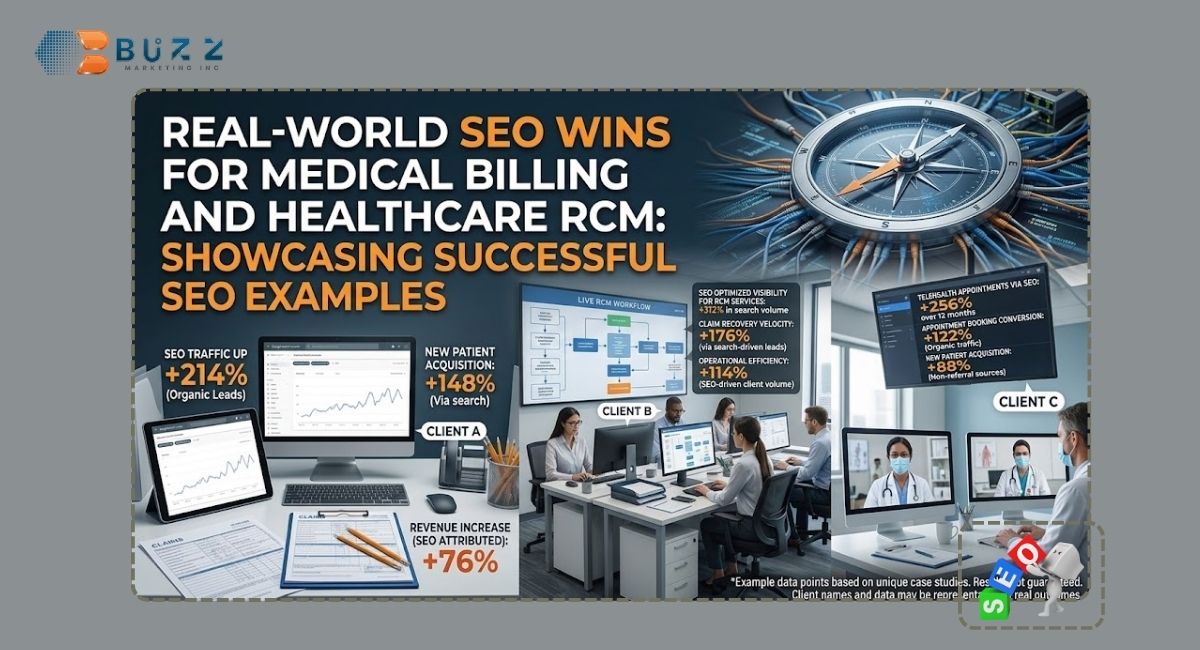
In the end, Showcasing successful SEO examples is not just about proving rankings. It is about showing how search visibility translates into real healthcare business growth, better client acquisition, and stronger market positioning.
For brands looking to implement this level of structured SEO execution, Buzz Marketing continues to support healthcare and RCM-focused digital strategies through specialized SEO, technical optimization, and content systems built for measurable outcomes.