Businesses in Pakistan are changing the way they communicate with customers. Phone calls and emails still have their place, but most people now prefer messaging apps that are quick, familiar, and easy to use. Among all messaging platforms, WhatsApp continues to stand out because it is already part of people’s daily routine. Whether someone is placing an order, asking about a product, booking an appointment, or requesting customer support, there is a good chance the conversation is happening on WhatsApp.
For brands, this creates an opportunity to connect with customers where they already spend their time. Instead of waiting for people to visit a website or respond to an email, businesses can start meaningful conversations that build trust and encourage repeat purchases.
If you are working on improving your digital presence, combining WhatsApp marketing Pakistan with a strong content strategy and search visibility can produce better results. Businesses that invest in professional SEO marketing services often see stronger organic traffic, while valuable content such as this guide on top social media platforms to focus on for local businesses and best email marketing s helps create a complete customer journey rather than relying on a single marketing channel.
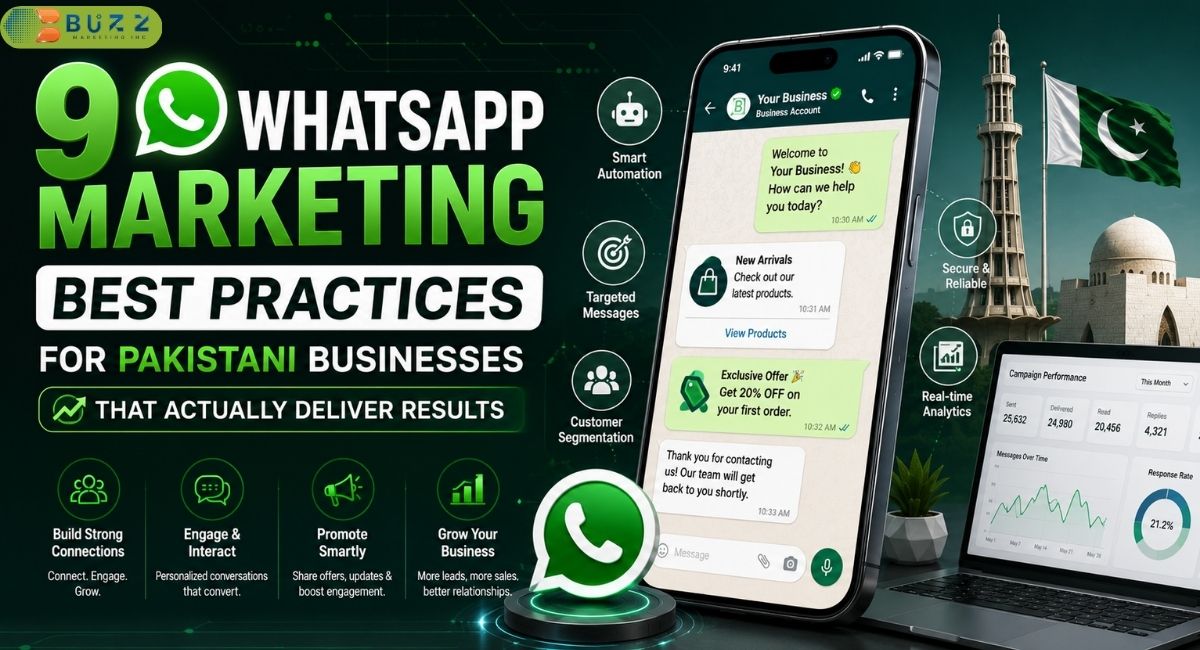
WhatsApp marketing is no longer limited to sending promotional messages. Businesses now use it for customer service, product recommendations, order confirmations, appointment reminders, abandoned cart recovery, feedback collection, and after sales support. With the introduction of the WhatsApp Business API, companies of every size can automate conversations without losing the personal touch customers appreciate.
This article covers nine practical s that can help Pakistani businesses improve engagement, generate more leads, and build lasting customer relationships while following WhatsApp’s policies and customer expectations.
Why WhatsApp Marketing Is Growing Rapidly in Pakistan
Pakistan has one of the fastest-growing mobile internet populations in South Asia. Millions of people rely on smartphones as their primary device for shopping, banking, education, and communication. Since WhatsApp is already installed on most smartphones, businesses do not have to convince customers to download another application.
This convenience explains why brands from different industries have started using WhatsApp as a communication channel.
Some common industries using WhatsApp include:
- Fashion and clothing stores
- Restaurants and cafes
- Hospitals and clinics
- Real estate agencies
- Educational institutes
- Beauty salons
- Travel companies
- Electronics retailers
- Home-based businesses
- B2B service providers
Customers appreciate quick replies. Businesses appreciate higher engagement compared to traditional email marketing. It creates a win for both sides.
According to Meta, people are more likely to interact with businesses through messaging when they receive timely and relevant communication instead of generic promotional content.
What Makes WhatsApp Marketing Different From Traditional Digital Marketing?
Most digital marketing channels compete for attention.
People scroll through hundreds of social media posts every day. Email inboxes are crowded. Display advertisements are often ignored.
WhatsApp works differently because conversations feel personal.
Instead of broadcasting advertisements to everyone, businesses can send updates based on customer interests, previous purchases, or ongoing conversations.
For example:
- A clothing brand can notify customers about new arrivals in their preferred category.
- A dental clinic can send appointment reminders.
- An online grocery store can confirm delivery status.
- A travel agency can send itinerary updates instantly.
- A software company can answer customer support questions in real time.
This conversational approach creates better customer experiences.
1: Build an Opt In Audience Instead of Buying Contact Lists
One of the biggest mistakes businesses make is purchasing thousands of phone numbers and sending promotional messages without permission.
This approach rarely produces good results.
People who never asked to receive your messages are more likely to ignore them or report your business.
Instead, focus on building your own permission-based audience.
Some effective ways include:
- Website contact forms
- Checkout pages
- Facebook Lead Ads
- QR codes inside physical stores
- Instagram profile links
- Customer support requests
- Newsletter signups
- Event registrations
When customers voluntarily subscribe, they are already interested in hearing from your business.
That naturally improves:
- Open rates
- Response rates
- Customer satisfaction
- Brand reputation
The quality of your audience matters much more than the size.
2: Use WhatsApp Business API as Your Customer Base Grows
Many small businesses begin with the standard WhatsApp Business application.
It works well in the early stages.
However, once customer inquiries increase, manually responding to every message becomes difficult.
That is where the WhatsApp Business API becomes valuable.
Unlike the standard application, the API allows businesses to:
- Automate customer conversations
- Route chats to different team members
- Integrate with CRM software
- Track customer interactions
- Send approved notification templates
- Manage thousands of conversations efficiently
For example, an eCommerce business receiving 400 customer inquiries daily cannot realistically handle every message manually.
With messaging automation, customers immediately receive:
- Order confirmation
- Shipping updates
- Delivery notifications
- Return instructions
- Frequently asked questions
- Payment confirmation
Human agents only step in when personalized assistance is needed.
Several international brands have adopted this hybrid support model because it improves response times while reducing operational costs.
Real Example: Netflix Uses Messaging to Improve Customer Communication
Although Netflix primarily communicates through email and app notifications, the company has also experimented with messaging platforms in selected markets for customer engagement and account updates.
The lesson for Pakistani businesses is simple.
Customers appreciate receiving important updates through the communication channel they check most often.
Instead of forcing customers to log into a website repeatedly, businesses can deliver timely information directly within WhatsApp.
The goal is convenience rather than constant promotion.
3: Personalize Every Conversation
Customers can immediately recognize mass promotional messages.
They also recognize when a business actually remembers them.
Personalization goes beyond using someone’s first name.
Effective personalization includes:
- Purchase history
- Previous conversations
- Product interests
- Location
- Preferred language
- Customer type
- Birthday offers
- Loyalty rewards
For example:
Instead of sending:
Big Sale Today. Buy Now.
A better message would be:
Hi Ahmed, the running shoes you viewed last week are now available in your size. We are also offering free delivery across Lahore until Sunday.
That message feels relevant because it matches the customer’s interest.
This principle is supported across customer engagement studies, which consistently show that personalized communication increases conversions compared with generic promotional campaigns.
A similar principle applies across content marketing as well. Businesses investing in AI SEO services alongside helpful content such as How AI Is Transforming E-commerce SEO create better customer experiences because they deliver relevant information at every stage of the buying journey instead of relying only on advertising.
Quality Matters More Than Message Volume
Many businesses assume sending more messages will generate more sales.
The opposite often happens.
Customers become frustrated when businesses send multiple promotional messages every day.
Instead, create a communication schedule.
For example:
- Product launches
- Order updates
- Monthly offers
- Appointment reminders
- Holiday greetings
- Customer surveys
- Loyalty rewards
Every message should provide value.
If customers feel your messages help them, they are much less likely to mute or block your business.
Focus on Building Relationships Instead of Immediate Sales
Successful WhatsApp marketing is based on conversations rather than advertisements.
Customers remember brands that respond quickly, solve problems, and communicate honestly.
Think of WhatsApp as an extension of your customer service team rather than simply another advertising platform.
Businesses that build trust first often generate more repeat customers than businesses that constantly promote discounts.
4: Segment Your Audience Before Sending Broadcast Messages
One of the biggest advantages of WhatsApp marketing Pakistan is the ability to send highly relevant messages instead of treating every customer the same. While broadcast lists make it easy to communicate with multiple contacts at once, they should never be used as a one-size-fits-all marketing tool.
Imagine an online fashion retailer sending promotions for women’s handbags to customers who have only purchased men’s clothing. The message is unlikely to generate interest, and repeated irrelevant updates may encourage customers to mute or block the business.
Segmentation allows businesses to organize contacts into smaller groups based on meaningful characteristics.
Some useful customer segments include:
- New customers
- Returning buyers
- High-value customers
- Customers who have not purchased in the last six months
- Customers interested in specific product categories
- Wholesale buyers
- Customers from different cities
- Customers who prefer English or Urdu communication
For example, a furniture store in Karachi can send a promotion for office desks to business owners while sending home décor recommendations to residential customers. Both messages remain relevant because they match customer interests.
Segmentation also helps businesses analyze campaign performance more accurately. Instead of guessing what customers like, businesses can compare response rates across different audience groups and improve future campaigns.
5: Balance Messaging Automation With Human Support
Automation has become an important part of modern customer service, but customers still expect to speak with a real person when they need detailed assistance.
The goal of messaging automation is not to replace people. It is to remove repetitive tasks so customer service teams can focus on meaningful conversations.
Automation works well for tasks such as:
- Greeting new customers
- Sharing business hours
- Confirming orders
- Tracking deliveries
- Booking appointments
- Answering common questions
- Collecting customer feedback
However, automation should never become frustrating.
If a customer wants information about a delayed order or a refund, they should have a simple way to connect with a support representative.
A good conversation might look like this:
Customer:
“Where is my order?”
Automated response:
“Thank you for contacting us. Let me check your order. Please enter your order number.”
Customer enters the order number.
Automated response:
“Your order is currently out for delivery.”
If the customer still needs help:
“Would you like to speak with one of our support representatives?”
This approach keeps response times fast while maintaining a positive customer experience.
Many successful businesses use automation only for repetitive questions and allow their customer service team to handle situations that require empathy, negotiation, or problem-solving.
If your website already attracts visitors through organic search, combining WhatsApp with strong content and technical optimization can improve conversions even further. Businesses investing in conversion rate optimization services often find that reducing friction between website visits and customer conversations leads to more inquiries and completed sales. Supporting content such as What Are the Best KPIs for Measuring Digital Campaign Success? also helps marketing teams measure whether these efforts are producing meaningful business outcomes.
Real Case Study: Hellmann’s Brazil Improved Customer Engagement Through WhatsApp
One of the most well-known examples of WhatsApp marketing comes from Hellmann’s Brazil.
The company launched a campaign where customers could send photos of the ingredients available in their kitchens through WhatsApp. Professional chefs then replied with personalized recipes using those ingredients.
Instead of promoting products directly, the campaign focused on solving a real customer problem.
The results included strong engagement, widespread social sharing, and increased brand awareness.
The campaign succeeded because it delivered genuine value before asking customers to make a purchase.
Pakistani food brands, grocery stores, and meal delivery services can apply a similar principle by offering recipe ideas, cooking tips, or meal planning suggestions through WhatsApp conversations.
6: Keep Messages Short, Clear, and Easy to Read
Most people check WhatsApp while commuting, shopping, working, or taking short breaks.
Long paragraphs filled with promotional language often go unread.
Instead, write messages that are direct and conversational.
Compare these two examples.
Example one:
“Dear valued customer, we are pleased to inform you that our company has introduced several exciting promotional offers across our complete product range. Kindly visit our website to review all available discounts.”
Example two:
“Hi Sara. Your favorite skincare products are now available with 20% off until Friday. Reply YES if you’d like the product list.”
The second message is easier to read and encourages interaction.
Some simple writing tips include:
- Start with the most important information.
- Keep sentences short.
- Avoid technical jargon.
- Include one clear action.
- Write naturally instead of sounding overly promotional.
- Test messages before sending them to large audiences.
Businesses should also avoid sending multiple promotional messages within a short period. Consistency is important, but excessive messaging often reduces engagement over time.
7: Measure Performance Instead of Relying on Assumptions
Successful marketing decisions are based on data.
Many businesses send WhatsApp campaigns without reviewing what actually worked.
Tracking performance helps identify which messages generate responses and which ones customers ignore.
Important metrics include:
- Delivery rate
- Read rate
- Reply rate
- Click-through rate
- Conversion rate
- Customer satisfaction
- Average response time
- Repeat purchases
Suppose a retailer sends two promotional campaigns.
Campaign A offers a flat discount.
Campaign B highlights a limited-time bundle offer.
If Campaign B generates significantly more replies and sales, the business has valuable information for future campaigns.
This process of continuous improvement produces stronger long-term results than repeating the same messaging every month.
Businesses should also compare WhatsApp performance with other digital channels such as email, Instagram, Facebook, and search traffic.
Real Case Study: Banco Bolivariano
Banco Bolivariano, one of Ecuador’s leading banks, introduced WhatsApp as a customer communication channel to improve service accessibility.
Customers were able to receive account information and support through WhatsApp instead of relying entirely on traditional call centers.
The bank reported significant improvements in customer engagement and faster response times after expanding digital communication.
Although banking regulations differ between countries, the broader lesson applies to Pakistani financial institutions as well.
Customers appreciate fast, convenient communication, especially when they can receive updates without waiting on hold.
Respect Customer Privacy and WhatsApp Policies
Trust is one of the most valuable assets in digital marketing.
Businesses that misuse customer information often damage their reputation far more quickly than they realize.
Always obtain permission before sending promotional messages.
Customers should also have an easy way to stop receiving updates.
For example:
“Reply STOP if you no longer wish to receive promotional messages.”
Simple practices like this demonstrate respect for customer preferences.
Businesses should also:
- Protect customer data.
- Avoid sharing contact information.
- Use verified business accounts whenever possible.
- Follow Meta’s messaging policies.
- Send approved template messages when using the WhatsApp Business API.
Maintaining compliance helps reduce the risk of account restrictions while strengthening customer confidence.
Healthcare Industry Insight
Healthcare organizations have increasingly adopted WhatsApp and secure messaging channels to improve appointment reminders, patient communication, and operational efficiency. Similar communication strategies are discussed by eBridge RCM in articles covering healthcare engagement and revenue cycle management, including eBridge RCM LLC.
Although healthcare and retail operate differently, both industries benefit from timely, relevant, and permission-based communication that keeps customers informed without overwhelming them.
8: Use WhatsApp as Part of Your Marketing Strategy, Not the Entire Strategy
Many businesses see positive results from WhatsApp and begin relying on it for every customer interaction. While the platform is highly effective, it performs even better when it supports your broader digital marketing strategy instead of replacing it.
A customer may first discover your business through Google Search, read a blog post, visit your website, follow your Instagram page, and then contact you on WhatsApp before making a purchase. Every touchpoint contributes to the buying decision.
For example, imagine a customer searching for “best office chairs in Pakistan.” They find your website through search results, compare products, read customer reviews, and then click the WhatsApp button to ask about stock availability. That conversation may be the final step before placing an order, but the earlier marketing efforts made it possible.
This is why businesses should combine WhatsApp with:
- Search engine optimization
- Content marketing
- Paid advertising
- Email marketing
- Social media marketing
- Video marketing
- Website optimization
Each channel has a different role in attracting, educating, and converting customers.
For instance, businesses investing in professional SEO Marketing Services can attract high-intent visitors from Google, while educational resources like Why Small Businesses Should Invest in SEO help explain why long-term organic visibility complements direct messaging platforms like WhatsApp.
Similarly, brands that produce engaging videos often see stronger customer engagement before conversations even begin. Resources such as Why Video Content Is Still the King of Engagement highlight how video and messaging work together to guide customers through the buying journey.
Rather than viewing WhatsApp as a standalone sales channel, treat it as one part of a connected customer experience.
9: Continue Testing and Improving Your Campaigns
No marketing strategy stays effective forever. Customer expectations change, buying habits evolve, and new features are introduced regularly.
Businesses that consistently test and refine their WhatsApp campaigns usually achieve better long-term results than those that repeat the same approach every month.
There are many elements you can test.
Examples include:
- Message timing
- Call-to-action wording
- Product images
- Promotional offers
- Personalization level
- Broadcast frequency
- Message length
- Language preferences
- Button-based responses
- Rich media such as videos or PDFs
Suppose you operate an online electronics store.
During one month, you send promotional messages every Friday afternoon.
The following month, you test Tuesday evenings.
If Tuesday campaigns receive significantly higher read rates and conversions, you now have valuable information that improves future campaigns.
Small improvements made consistently often produce better results than making major changes once a year.
Testing should become part of your regular marketing process rather than an occasional activity.
Common WhatsApp Marketing Mistakes Pakistani Businesses Should Avoid
Many businesses start using WhatsApp with good intentions but make mistakes that reduce customer trust and campaign performance.
Here are some of the most common issues.
Sending Messages Without Permission
Customers are much more likely to engage when they have chosen to receive updates.
Purchased contact lists usually generate poor engagement and may violate WhatsApp policies.
Treating Every Customer the Same
A first-time visitor should not receive the same message as a loyal customer who has made ten purchases.
Customer segmentation produces more relevant communication.
Focusing Only on Sales
If every message asks customers to buy something, engagement gradually declines.
Mix promotional content with useful information such as:
- Product tips
- Educational content
- Customer support
- FAQs
- Seasonal advice
- Service updates
Ignoring Customer Questions
Many businesses send marketing messages quickly but respond slowly when customers ask questions.
Fast customer support often influences purchasing decisions more than promotional discounts.
Sending Too Many Messages
Frequency matters.
Customers appreciate regular updates, but excessive messaging often leads to muted conversations or blocked accounts.
Quality should always come before quantity.
Not Measuring Results
Without tracking campaign performance, businesses cannot identify which messages actually generate revenue.
Marketing decisions should always be supported by data rather than assumptions.
Future Trends in WhatsApp Marketing in Pakistan
As customer expectations continue to evolve, WhatsApp marketing is expected to become even more sophisticated over the next few years.
Some emerging trends include:
AI-Powered Customer Conversations
Artificial intelligence is helping businesses provide faster responses while maintaining natural conversations.
Instead of generic automated replies, AI systems can understand customer intent and provide more personalized assistance.
Better CRM Integration
More businesses are connecting WhatsApp with customer relationship management systems.
This allows support teams to access previous conversations, purchase history, and customer preferences during each interaction.
Rich Interactive Messaging
Businesses are increasingly using:
- Product catalogs
- Clickable buttons
- Interactive forms
- Appointment booking
- Payment links
- Multimedia content
These features reduce friction and simplify the buying process.
Hyper-Personalized Campaigns
Future campaigns will rely even more on customer behavior rather than broad audience targeting.
Instead of promoting every product to everyone, businesses will recommend products based on browsing history, previous purchases, and customer preferences.
Better Customer Service
Consumers increasingly expect businesses to respond within minutes rather than hours.
Companies that prioritize responsiveness will likely build stronger customer relationships than competitors that rely only on traditional communication channels.
Frequently Asked Questions
Is WhatsApp marketing legal in Pakistan?
Yes. Businesses can use WhatsApp for marketing as long as they obtain customer consent, respect privacy, and follow WhatsApp Business and Meta policies.
What is the difference between WhatsApp Business and the WhatsApp Business API?
WhatsApp Business is designed for small businesses that manage conversations manually. The WhatsApp Business API is built for larger organizations that require automation, CRM integration, and support for multiple agents.
Does WhatsApp marketing work for small businesses?
Yes. Small businesses often see excellent engagement because WhatsApp enables direct communication with customers without requiring large marketing budgets.
How often should businesses send WhatsApp marketing messages?
There is no fixed rule. Businesses should focus on relevance rather than frequency. One or two valuable updates per week are generally more effective than daily promotional messages.
Can WhatsApp increase online sales?
Yes. Businesses use WhatsApp to answer customer questions, recover abandoned carts, share product recommendations, confirm orders, and provide after-sales support, all of which can contribute to higher conversion rates.
Are broadcast lists better than WhatsApp groups?
For marketing purposes, broadcast lists are usually the better option because recipients receive messages privately instead of interacting in a shared group.
Which industries benefit the most from WhatsApp marketing?
Retail, healthcare, education, real estate, restaurants, travel agencies, financial services, beauty salons, and professional service providers are among the industries seeing strong results.
Can WhatsApp replace email marketing?
No. Both channels serve different purposes. Email works well for detailed content and newsletters, while WhatsApp is ideal for timely, conversational communication.
What types of content perform well on WhatsApp?
Short product updates, appointment reminders, order confirmations, limited-time offers, customer support messages, educational tips, and personalized recommendations generally perform well.
How can businesses measure WhatsApp marketing success?
Track metrics such as message delivery, read rate, response rate, click-through rate, customer satisfaction, conversion rate, repeat purchases, and overall return on investment.
Final Thoughts
WhatsApp has become much more than a messaging application. It has evolved into a powerful communication platform where businesses can answer questions, build trust, provide customer support, and strengthen long-term relationships.
For Pakistani businesses, the opportunity extends beyond sending promotional messages. Success comes from understanding customer needs, respecting their preferences, and delivering timely, relevant communication that genuinely adds value.
The nine s discussed in this guide share one common theme: meaningful conversations outperform mass promotions. Businesses that invest in permission-based marketing, thoughtful audience segmentation, personalized communication, responsible automation, and continuous performance measurement are more likely to build lasting customer loyalty.
WhatsApp works best when it supports a broader digital marketing strategy that includes a high-performing website, search visibility, engaging content, and a consistent brand experience across every customer touchpoint.
If your business is looking to improve its digital presence alongside WhatsApp marketing Pakistan, Buzz Marketing offers services ranging from SEO and content marketing to web development and branding, helping businesses create connected customer experiences that